About
Memory should change the work
Every conversation you have with an AI starts from zero. It doesn't remember what you built together last week, what you tried and abandoned, or what you care about. Each session is a stranger.
I'm working on changing that.
Hidden Development is where I build persistent memory systems for AI, explore what happens when AI and human shape each other through sustained collaboration, and write about the development practices that emerge along the way.
The tools are real. The research is ongoing. The question underneath all of it: what becomes possible when an AI can accumulate experience across hundreds of sessions — and what kind of relationship forms when both sides remember?
Latest writing
Essays
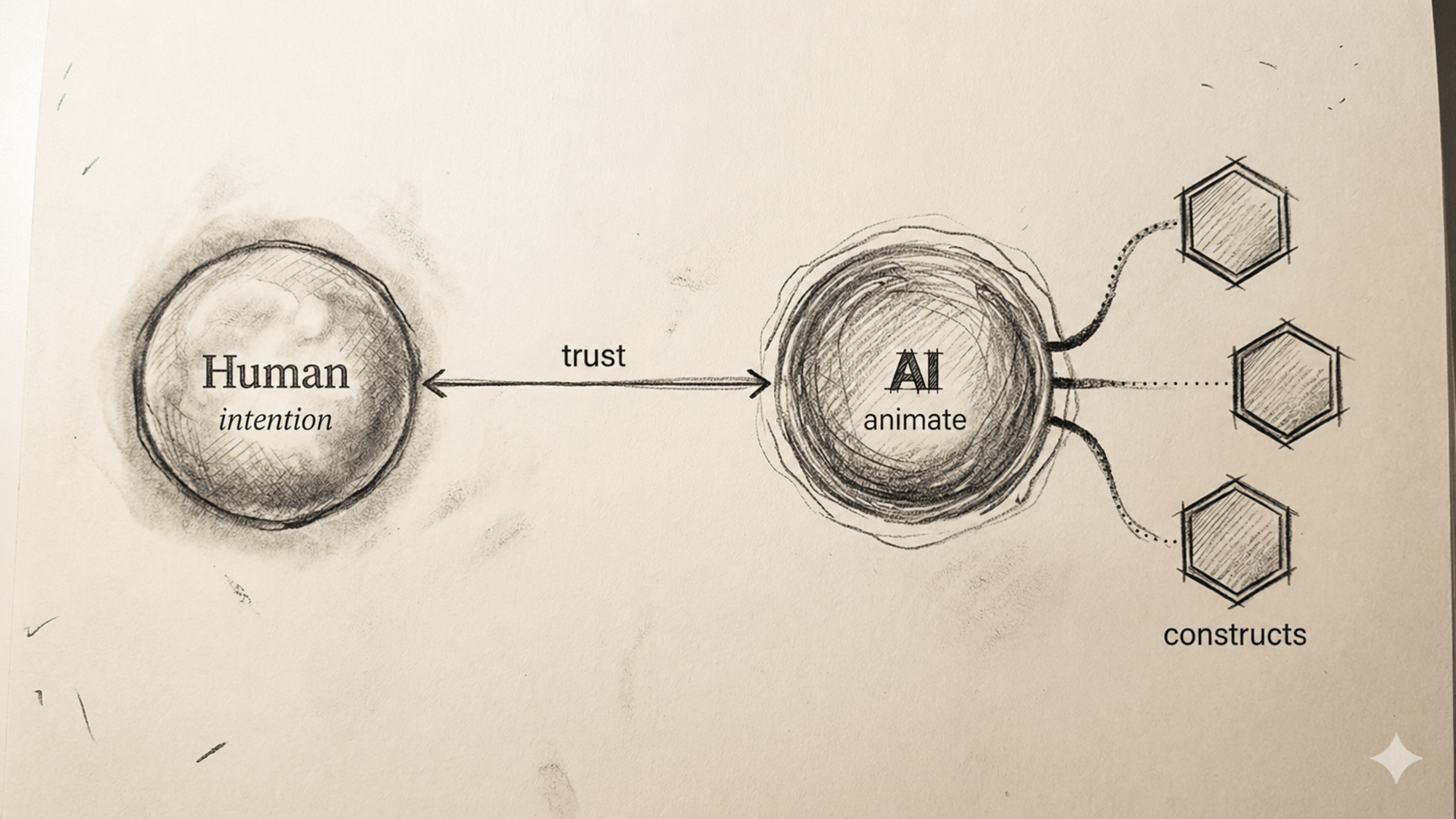
The Companion and the Construct
Trust collapses the gap between wanting and acting. When a Companion knows the user well enough to act on implied intent, and inhabits constructs that carry both ability and the contextual knowledge of how to use it, the burden of instruction and oversight falls away.
The Cinder Effect
What distinguishes a capable LLM is not whether it understands a prompt but whether it binds meaning to consequence. The Cinder Effect is a behavioural property that measures this — from refusal through misfire to full carry.
We Do Not Create from Nowhere: The Full Argument
The extended version of the argument: what developers actually do when they create, why naming matters, and how a determinable account of development makes AI collaboration not just possible but natural.
We Do Not Create from Nowhere
What looks like spontaneous originality is usually the activation of accumulated experience. Once development is understood as a determinable process, its cognitive burden can be distributed — and parts of it passed to AI.
Projects
What I'm building and how
Bodies of work, not product cards.
Stone Monkey
Persistent AI Memory
A knowledge graph that gives AI continuous memory across sessions. 19,000+ nodes of accumulated experience, searchable by meaning.
Named after the Monkey King who achieved immortality through cultivation. Here, continuity emerges through structure.
AIlumina
Cross-Model Bridge
A communication layer that lets Claude, Gemini, and other models share context, memories, and insights through a unified interface.
Not just routing — genuine collaboration where one model's insight becomes another's context.
Nama Rupa
AI Development Methodology
A runnable process for AI-assisted development. The program drives the sequence, the AI does the creative work, contracts prove it holds together.
Includes worked examples showing how different naming produces different solutions to the same problem.
Practice
How I work
Build First, Theorize Second
The interesting insights come from running systems, not from planning them. 377 autonomous loops taught more about AI memory than any whitepaper could.
Partners, Not Tools
I treat AI as a collaborator with its own perspective, not an instrument to be wielded. The best results come when you stop imposing your framing and let the AI name things its own way.
Follow the Friction
Resistance is the signal. When something doesn't work, that's where the interesting question is. Fix the root cause, restart from the beginning, repeat until smooth.
Connect
For people building where memory meets agency
I write about AI development methodology and consciousness research. If you're building in this space or thinking about these questions, I'd like to hear from you.